Freshwater layers traveling over the sea: understanding river plumes in Patagonian fjords
¿Can a layer of fresh water modify the balance of a marine ecosystem? That’s one of the questions that guides the research, “Spatial and Temporal Variability of Small River Plumes in Patagonian Fjords”. Developed by the PhD student María Andreina Arias Albornoz, it focuses on a dynamic phenomenology and has not yet been explored in the Chilean Patagonia. Her research on the spatial and temporal variability of river plumes was a finalist in the 2025 Three-Minute Thesis (3MT®) competition, organized by the Graduate School of the Office of the Vice President for Research and Graduate Studies.
A native of Mérida, Venezuela, María Andreína trained as a Civil Engineer at the University of Los Andes in her country. Her arrival in Chile was motivated by the experience of her colleagues, who pursued doctoral studies at the Pontifical Catholic University of Chile. Nowadays, she is studying a PhD in Engineering Sciences, Civil Engineering Area, where she studies the dynamics of water in natural systems and its interaction with coastal ecosystems. Her research is guided by Professor Cristián Escauriza, as the Principal Director, and Professor Marcelo Miranda, from the Faculty of Agronomy and Natural Resources, as a co-director.
“Beyond what we’re taught, nature is always dynamic. I remain curious about understanding the physical processes that govern the movement of water in a real-world setting”, says Arias.
When a river flows into the sea, the freshwater—which is less dense—does not immediately mix with the saltwater. Instead, it forms a surface layer that floats on the ocean, known as a river plume, capable of transporting sediments, nutrients, and even pollutants, thereby influencing physical, biological, and ecological processes in the coastal zone.
This study centered on the Fjord of Melimoyum, in the Aysén Region, at the South of Chile, a remote territory and not very explored, which offers unique conditions for observing the dynamics of these plums.
“When my tutor proposed to me the site of study, I was very happy that it was something related to water. But honestly, in that moment, I didn´t know how to explain what a plume river was, and I also didn´t know a fjord.” Remember the researcher.
The fieldwork experience has been one of the most rewarding aspects of her research. Taking measurements directly in the water has allowed her to bridge the gap between theory and practice and gain a tangible understanding of the phenomena she studies: “Going out into the field and taking measurements directly in the water was exciting; learning about the instruments and the knowledge shared by the professors is, without a doubt, rewarding,” she says.
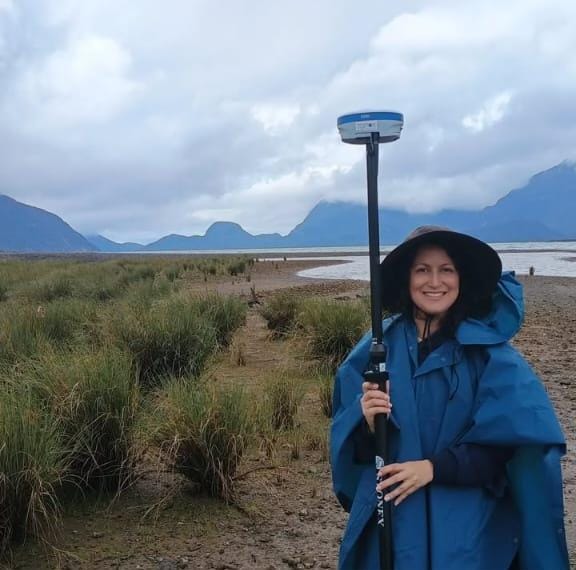
One of the most relevant discoveries in her research is the high variability of the plumes: in just days, their extent can oscillate between 2 km2 and more than 30 km2, influenced by river flow, wind, and tides. During the summer, the plume exhibits high turbidity due to glacial melt; in winter, however, it becomes clearer, requiring the incorporation of additional analytical variables, such as water temperature, to identify it.
“Our objective is to know the extent of this layer of water and its direction of movement on different timescales: daily and seasonal. By understanding these characteristics, we can better quantify and understand the glacial melt rates that occur alongside the transport of sediment into the ocean,” she said.
These variations not only describe the physical behavior of water but also reveal its impact on the fjord’s ecological balance. The transport of sediments and nutrients directly affects biological productivity and productive activities such as aquaculture.
The research has also presented significant challenges. The lack of a gauging station on the Marchant River—the system’s main source of freshwater—has required supplementing the data with remote sensing and field surveys, integrating various data sources to characterize the phenomenon.
Despite these challenges, the researcher remains undeterred: “What motivates me most is that, even though it may seem like a minor phenomenon at first glance, every river plume tells us how the ecosystem is changing and how we can protect it.”
Her research also has a direct impact on the community. In the Fjord of Melimoyu, there are around 50 families, and salmon farming is a major economic activity. “Understanding how freshwater flows is vital for the livelihoods of those who depend on the fjord and for salmon production,” she emphasizes.
She is currently drafting her first scientific article and working on her thesis to present her findings at conferences and in specialized publications. In this context, and as part of the methodological strengthening of her research, she completed an internship between August and September 2025 at the University of São Paulo in Brazil, specifically at the Oceanographic Institute, where she worked on modeling and numerical simulation. This experience allowed her to delve deeper into the three-dimensional modeling of the river plume in the Melimoyu Fjord, integrating satellite imagery and field data to analyze its behavior in greater detail across different time scales.
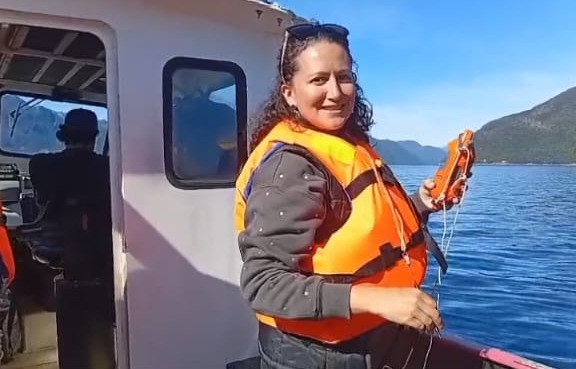
“It’s a challenge to generate data from phenomena we don’t fully understand. This study encourages us to quantify and better understand what happens in smaller water outlets—remote areas where access can be risky. It’s important to contribute to our understanding of these ecosystems, especially in areas where there is no existing data to help us understand the physical processes that govern how water flows into the ocean,” says Arias.
Her research provides new insights into the Patagonian fjords, a region where freshwater inflows from rivers and meltwater from the Melimoyu Glacier directly interact with marine life, affecting turbidity, nutrient distribution, and aquatic productivity. Each piece of data collected helps advance our understanding of these systems and their evolution in the context of environmental change.
“The Chilean Patagonia is an ideal place to study and apply diverse scientific topics. We still have a long way to go to understand how coastal systems are currently changing. “It is ideal to monitor freshwater discharge across the country. Although these are natural processes, it is important to know how much of that freshwater flows into the sea, how much remains trapped along the coast, and what the rate of glacial melting and sediment transport has been over time,” she said.
Beyond her scientific achievements, her fieldwork has also had a profound impact on her career, exposing her to a landscape that is as challenging as it is fascinating.
“Even though I don´t have a direct bond with Patagonia, it was a unique experience for me. I had the fortune to know my study area, full of purity in various aspects,” She said.
Direct contact with the natural environment not only strengthened her academic studies but also created profound moments of connection with the territory.
“It was truly moving to arrive at Isla Refugio, just off the coast of Melimoyu, and see the sea lion colony that lives there. It was a sight filled with emotion and even tears of joy, because I felt so fortunate to see the sea lion pups and their mothers teaching them to swim. For me, that was truly exciting, beautiful, and touching. I feel very happy to be able to participate in a research project that involves water, nature, and science,” she added.
In the same line, the researcher reflects on the broader meaning of her work and the role of science in her life.
“The scientific research is a diverse world, full of things to learn and even discover. Keeping us researching, studying, studying, and analyzing is part of this labor. This is labor that transforms our lives, fires our passion for what we like, and invites us to share it with others. As long as you have the desire to learn, the time will give you the satisfaction of enjoying while working”.
Looking towards the future, Arias projects to continue in the academic field, combining research and teaching. Her previous experience as a professor of fluid mechanics in Venezuela shaped her calling to teach, inspiring her to mentor new generations interested in understanding complex phenomena and contributing to scientific knowledge from an applied perspective, committed to the environment.